

Historians have a favorite Story about Gouverneur Morris.
It goes like this: Morris lost his Leg fleeing the angry Husband of a married Woman.
A Scandal. A Window. A Leap. A shattered Limb.
Moral Lesson delivered.
The Anecdote appears in Lecture Halls, Biographies, historical Discourse and any Article that wants to paint Morris as the resident Libertine of the Founding Era.
“The Rake who wrote the Constitution”. The “Playboy Founder.”
The Eighteenth-Century Fuckboy with a powdered Wig.
There is just one Problem. The Evidence for the Story is extremely thin.
The original Source: “I heard it from a guy.”
But Historians repeat it anyway because it is entertaining.
Which is unfortunate.
Because the historical Record actually contains Something much better:
Evidence that Morris really was reckless.
Just not in the Sheets…
But in the Streets.
The Famous Crash
Robert Morris’ Biographer Charles Rappleye describes the Accident in far less scandalous Terms than the popular Legend:
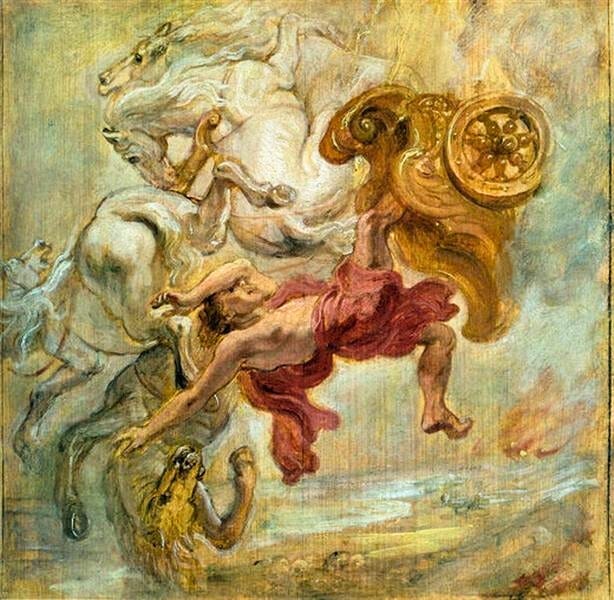
May 1780 […] Gouverneur was maimed in a freak accident. Clambering aboard his chariot for a Sunday visit to a friend in Maryland, Morris startled the two horses in harness and they jumped before he could grab the reigns.
His leg caught in a wheel and was broken in several places. Doctors immediately decided to amputate, and severed his leg just below the knee.
Still just twenty-eight years old, Gouverneur survived the surgery with his health and his jovial spirits intact.1
No Window.
No Cuckold Husband.
No Dive Roll into the Shrubbery.
Just Horses.
Very fast Horses.
And a Man who apparently mounted his Carriage with the same furious Enthusiasm he applied to everything Else in Life.
But wait, I’m sure you’re all wondering;
“What does Founding Father, Superintendent of Finance, and Signer of the Declaration of Independence Robert Morris have to do with any of this?”
Robert Morris was Dom Toretto to Gouverneur’s Brian O’Conner.
They were ride or die.
2 Men, 1 Revolution, and No Brakes
Not related by Blood, but bound by the Hustle:
Politics, Money, and the American Revolution.
Or, as one Nineteenth-Century Observer put it:
Mr. Gouverneur Morris, who, not a relative, was the best true friend Robert Morris ever had.2
These words were written in 1878 by Charles Henry Hart, Researcher of Robert’s formidable Wife Mary White Morris.
And just like all Women in History, Mary Morris deserves far more Attention than she usually receives.
Born in Philadelphia in 1749, Mary White married Robert Morris before she was twenty and quickly became a respected Hostesses in American political Society, residing over one of the most influential Households in the young Republic.
Contemporary Observers describe her as a Woman of Dignity, Intelligence, and social Command whose House became a gathering Place for Diplomats, Officers, and Statesmen passing through the Capitol.
Her Home functioned as one of the quiet Engine Rooms of the Revolution and its Exhaust Emission.
Gouverneur Morris was not merely an occasional Guest there.
He was Part of the Crew.
Much like his lifelong Bond with the Platers3, the Morris Household became one of the Places where Gouverneur mattered like a Family Member, which becomes clear in a Moment never mentioned in his own History.
When Mary’s Mother died in 1790, Robert Morris immediately wrote to Gouverneur in Paris to tell him the News—because he knew Gouverneur cared deeply about her.
Philadelphia, Jan’y 2d, 1791.
My Dear Friend
I have just parted from my family, who are all in mourning. Old Mrs. White, my wife’s mother, now lies a corpse in her own house. She expired on Friday evening, the 31st ult., after a short illness, occasioned by a severe cold taken accidentally, and treated with neglect until too late. She did not suffer much pain, and being in her 71st year, her end was to be looked for ; but notwithstanding these circumstances it came unexpectedly, and therefore has given a greater shock to the feelings of her two children than otherwise it would.My wife told me a while ago, when I mentioned that I had been writing to you, that she recollected you having often professed a regard and esteem for her mother, and therefore requested me to mention the decease to you.
The old lady was a sensible, good woman, and as such, exclusive of all considerations of connection, I valued and respected her exceedingly. We have ever been on terms of the most friendly intercourse, and I regret the loss of her as much as if she had been my own mother. Her daughter grieves at the loss, but has too much sense and too much integrity of mind to make parade of grief.
Tomorrow we shall attend her remains to the grave, at least myself and my children will ; but I do not intend that Mrs. Morris shall, for the weather is extreamly cold, and I do not choose that she should risque her health.
I hope, my dear Governeur, that you and I may live long enough to meet again in this world. I declare to you, if I were to indulge a doubt of it, my happiness would be much diminished, and my stock of happiness has already been so much curtailed by adversity that I can spare very little of the little now left.
I hope that you may long be spared an ornament of your species ; an honor to humanity, and be permitted the full enjoyments of all the happiness that man is capable of. Fare well. You never had nor ever will have a more sincere Friend than ROBT. MORRIS.4
Robert’s Letter carries so much genuine Affection — it is not addressed to a passing Libertine in his Social Orbit. Gouverneur was also much more than just a Business Associate.
When Robert’s financial Empire collapsed and he was thrown into Debtor’s Prison, Gouverneur quietly arranged for Mary to receive an Annuity from the Holland Land Company, ensuring she could maintain a Household and live the Rest of her Life with Dignity.
The supposed “Playboy Founder” spent Years making sure his best Friend’s Wife and Kids would not fall into Poverty.

It is a Movie-worthy Story:
Founding Fathers…
Age-gap Friendships…
The American Dream Hustle…
… and a young Upstart with an undeniable Need for Speed.

But hold on! I know what you’re all thinking:
“A Single vehicular Accident makes a weak Framing for a Founding Father with a Need for Speed.”
T’is true. One Accident can be dismissed as Misfortune.
If I want to disprove the Myth of Morris the reckless Seducer and establish him instead as a recklessly enthusiastic Driver, I need something better.
Something concrete...
Something embarrassing…
Something historically traceable…
Most preferably…
another documented self-provoked Totaling of a Carriage.
Extremely conveniently for this Essay’s Narrative this Gentleman was happy to contribute exactly that and served.
Or rather—
swerved.
2 Fast 2 Furious
In May, Gouverneur Morris crashed the phaeton while driving too fast down main street in Richmond—his earlier accident had failed to reform his reckless streak.
After helping Gouverneur out of the wreck, [Robert] Morris faced a small crisis of conscience. Should he buy a new carriage? He decided against it, explaining to Mary that “I cannot bear the idea of insulting my creditors by making a show in any way whilst I am in debt and not able to pay as fast as I ought.”5
Gouverneur’s first Accident, apparently, had not permanently moderated his Habits.
This second Incident which happened in 1788 never appears in Gouv Morris’s Biographies.
Which is unfortunate. Because it answers a very useful historical question:
Was Morris reckless?
Yes.
Was it sexual?
Not necessarily.
Was it vehicular?
Absolutely.
If the eighteenth Century had Sports Cars, Morris would have owned one.
And he would have crashed it.
Probably twice.
The Irony, of Course, is that Historians have spent Generations repeating an unfounded scandalous Story about Morris’s sexual Recklessness when actual Sources offer a much better Explanation.
He was not fleeing a Husband.
He was simply driving too fast.
And unlike the jealous-Husband Story, that one actually happened.
Twice.
Rappleye, Charles. Robert Morris - Financier of the American Revolution. Simon & Schuster, 2010. p. 203.
Hart, Charles Henry. Mary White - Mrs. Robert Morris. The Pennsylvania Magazine of History and Biography Vol. 2 No. 2, 1878. p. 157-184. [PDF available at jstor]
Care and not Conquest

This Essay seeks to peel back the Myth of Gouverneur Morris as “the Rake” among the Founding Fathers further and restore him to the Fullness of who he was: brilliant, neurodivergent, deeply wounded, and longing for Love, Kinship, and Care above all. Not Conquest, as most Biographers so far would have u…
Hart, Charles Henry. Mary White - Mrs. Robert Morris. The Pennsylvania Magazine of History and Biography Vol. 2 No. 2, 1878. p. 157-184. [PDF available at jstor]
Rappleye, Charles. Robert Morris - Financier of the American Revolution. Simon & Schuster, 2010. p. 444.