

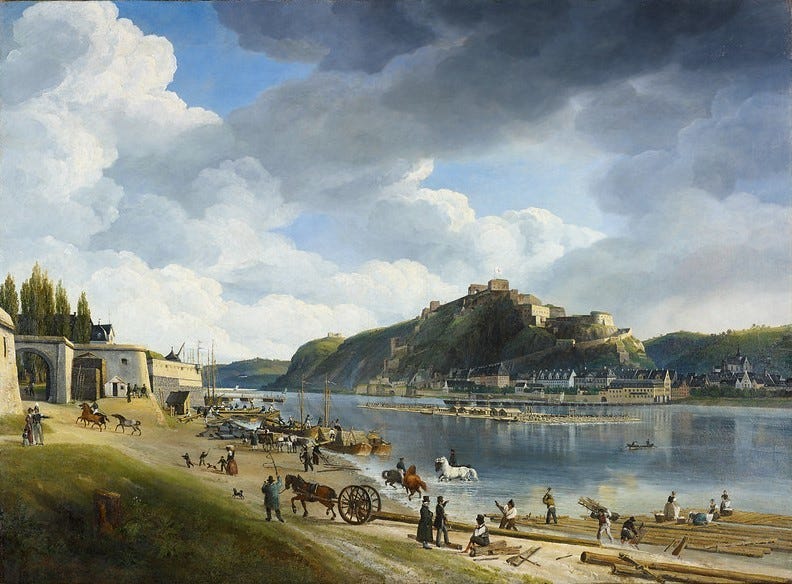
After Gouverneur Morris had the Privilege of being Impressed he traveled from London via the Netherlands and Belgium, through Germany, back to Paris.
October 1790, he departs from Bonn.
…Or rather, he attempts to.
Thursday 21. — This Morning I cannot get off as I expected at six oClock for Want of Post Horses. They are all engaged by Travellers who spoke before me. One Set however, which went to Cologne at one OClock, return so early as that I depart with them at a Quarter before ten. We travel but slowly which is pardonable as the Cattle are fatigued. (…)
We meet at the Post House [ in Remagen ] (or rather we are overtaken by) a british Messenger who left London last Sunday Evening. (…) He gets Horses before me and promises to have a Set ready for me at Andernaught.
We are a full Half Hour in changing Horses and our Postillion is determined not to redeem the Moments, but verifies what the Messenger obvserved to me: ‘This is a terrible Country, Sir, to travel in ; they are extremely slow and if you try to hasten them they are still slower.’
My Servant gets quite out of Humor with his Countrymen, for his Perswasions are treated with silent Contempt. He observes very justly that such a People are not fit to be free, they must have a Master.In two Hours and three Quarters we arrive at Andernaught, which is but about 15 Miles if so much, and the Road excellent. The Horses are ready at this Place but yet we are detained a Quarter of an Hour to put them to, and when we get out the City we go a considerable Distance upon a Walk, because the Road being here newly covered with Gravel he takes it in his Head that it is too heavy for three strong Horses tho quite level. Attempts to perswade him are ineffectual and my Wish to get to Coblentz before Night is of no Use either to him or me.
About Half or indeed two Thirds of the Way towards that Place we meet another Post-Chaise and they change Horses in Spite of me. The Persons who are in it sit quietly and resigned. And yet it is they who have really Cause of Complaint, for my new Rider and Horses bring me on at a Rate which I have not known since I embarked at Dover. (…)
At entring Coblentz we cross the Moselle on a fine stone Bridge. The Distance from our last Post is about twelve Miles which, thanks to our first Postillion, consume two Hours and a Half.
(…) I order Dinner immediately on my Arrival, which is half past six. It is to be ready immediately whereas the Table d’Hôte, which is spread, will not be furnished till eight.
At Half past Seven, finding no Appearances of Food, I offer mine Host a Bet that he will serve me as others have done, keep me waiting to spoil my Meat by over roasting it. He assures me that his Cook is excellent and that the Taste of People here is to eat Things with the Juice in.
At eight oClock a Part of the Food designed for the Table d’Hôte is sent into my Chamber and the first Dish is a kind of Stew called Soup, made of greasy Crusts, which of course I do not touch, nor the Spinnage which accompanies it.
To this succeeds a Piece of Veal which was ready dressed when I arrived, for my friend the Messenger dines off it a few Minutes after. This serves to stay the Stomach of my Dog. Then comes a sodden Partridge, not roasted to Rags but half stewed, half baked till it has neither Juice nor Taste. I complain in pretty severe Terms and they bring me a Shoulder cut from Calf, but the poor Creature was I believe starved to Death.
Hungry as I am the Sight excites a Nausea so that I cannot even see my Dog eat it.They had promised some Grives but luckily forgot it, wherefore I desire they may be roasted immediately, and a few Minutes after send down my Servant, whose earnest Supplications obtain them from the Cook while yet eatable, but as the Devil would have it they have eaten so many Juniper Berries that they are a Kind of solid Gin.
There remains no Resource but salt Cheese made of Hog’s Head which would have been very good had it been fresher (ie) newer. Mustard would have been a good Accompanyment to it but they have none.
This Evening is if possible finer than the Day has been.
Dear Reader,
I know what you’re thinking.
On the Surface this reads like the familiar Complaint of an impatient, aristocratic Traveler: Post Horses unavailable, Roads too slow, Food inedible, Servants incompetent.
But as it is always the Case with Mr. Morris there is much more to his Words than Grievance. It is Farce. Morris is not raging. He is observing, cataloguing, and —most crucially— documenting what he does, when things spiral outside his Control:
Laugh.
A Grand Comedy of Obstruction
Gouverneur Morris could have documented this Day like any other. In Measurements, economic and environmental Reflection, Soil Quality Assessment, Husbandry Condition Discernment, or Value and Currency Query, but no.
On this day Everything resists him. Others wake earlier than he does. Horses are fatigued. Roads are newly graveled and therefore Travelers “too heavy” in the Imagination of Idiots. Postillions refuse to hurry on Principle. Diplomatic Persuasion is met with silent Contempt. Other Travelers accept arbitrary Decisions and Incompetence with monkish Resignation. And the one Moment real Speed appears, it does so against his Will and only for Irony’s Sake.
And all of this occurs before the first Meal.
I know Jokes that need explaining are usually simply not funny.
But these ones will be worth it and the last one comes with no Elaboration at all.
“He observes very justly that such a People are not fit to be free,
they must have a Master.”
Martin’s Remark was not delivered from a Lectern. It is spoken beside a stalled Carriage, in Mud and Frustration, after Hours of pointless Delay.
Martin Bromeling, a Mannheim Native and Gouverneur’s Friend and Servant for many Years, has argued, pleaded, reasoned, and been ignored by his fellow Germans. So when he finally and frustradedly returns to Gouverneur to report what his Countrymen have said, he just shakes his head.
“You know what? Freedom for my People was a fundamental Mistake.”
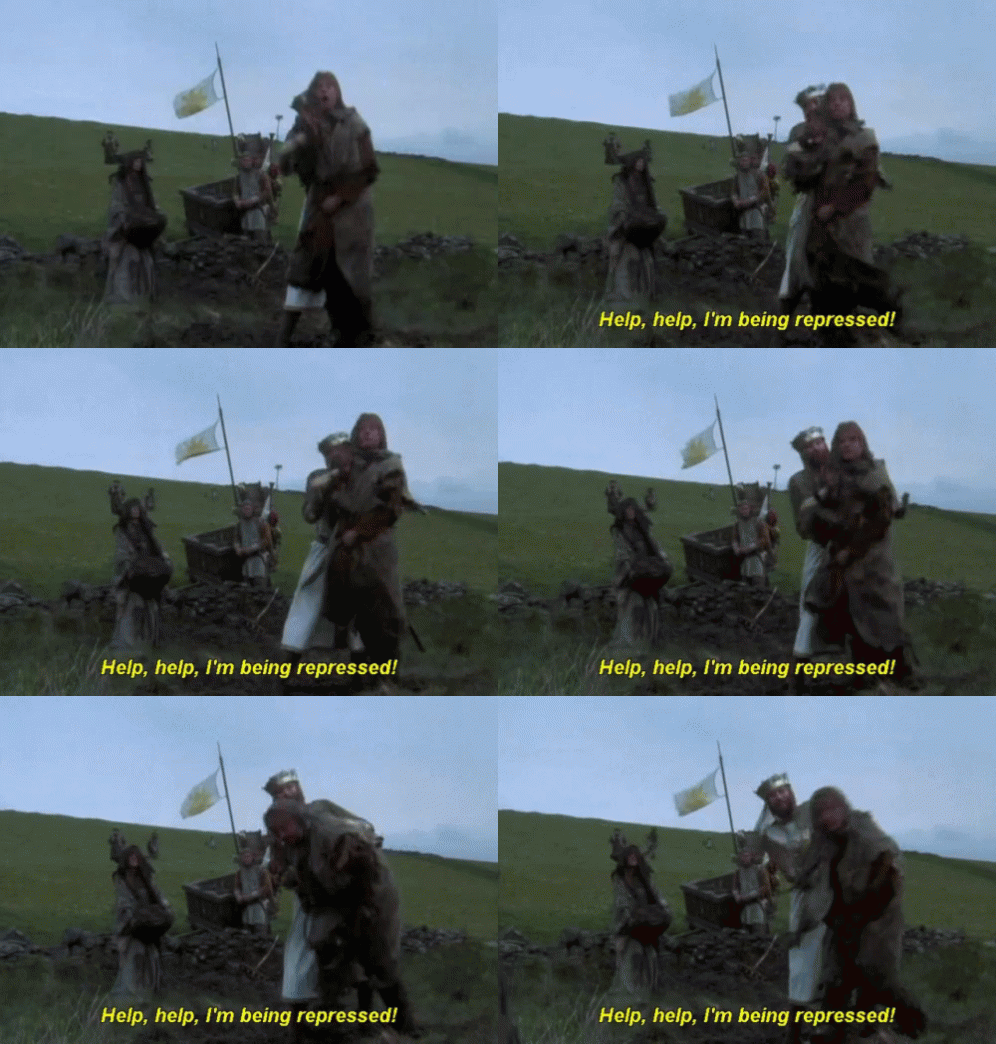
Morris records the Sentiment because it is outrageous in Context. It inverts every Principle he holds dear. Liberty, to him, is never a Reward for Obedience, but a Discipline that requires Competence.
In that Moment, Freedom has nothing to do with Rights and everything to do with whether a Professional will hitch three perfectly capable Horses to a Carriage on a level Road in under an Hour without authoritative Pressure.
“We go a considerable Distance upon a Walk”
A silent Banger and a perfect Joke because of how quietly insane it is.
The Scene is completely absurd, but what makes it so funny is not him, Martin and the large Newfoundland Dog Gouverneur purchased as a present for the Duchess of Orleans walking behind Horses and a Post Carriage. It is the syntactic Calm with which he reports something completely deranged. Bureaucratic Serenity at its best.
Morris paid for the Carriage, able Horses, and with the Fare even chipped into the Fortification of the Road.
Just someone else’s Will to use any of them was not purchasable.

“My Wish to get to Coblentz before Night is of no Use
either to him or me.”
By this Point in the Day Team Morris has been awake since before Dawn.
They were prepared to depart at six in the Morning and instead sat detained until nearly ten. They were stalled again in Remagen until one in the afternoon, and in Andernach until four. By then, after eleven Hours of Effort, Irritation, and Negotiation, they had covered roughly twenty-eight of the forty Miles between Bonn and Koblenz.
Morris does the math.
And then, quite deliberately, he abandons it.
Earlier, moving slowly with fatigued Horses, they had made thirteen Miles in two hours and forty-five Minutes. The remaining twelve Miles—on a fortified Road, with fresh Horses—would normally require perhaps an Hour and a half, two at the very most.
His Calculation is sound.
And it is also useless.
It belongs to a World in which Things still respond to Reason.
So when all Negotiations for Common Sense collapse against the impenetrable Wall of German Tenacity, Morris turns to his final, civilized Resource:
Sarcasm.
“One would have to walk to not make it to Koblenz before Nightfall.”
“About Half or indeed two Thirds of the Way towards that Place we meet another Post-Chaise and they change Horses in Spite of me.
The Persons who are in it sit quietly and resigned.
And yet
it is they who have really Cause of Complaint,
for my new Rider and Horses bring me on at a Rate
which I have not known since I embarked at Dover.”
On Post Roads, Horses were not attached to a Traveler; they belonged to the Route.
When two Post-Carriages met, Officials could decide to reassign Horses based on Priority, Timing, or…
pure Arbitrariness.
In this Case, Morris clocks immediately that the Decision is motivated by Spite.
It is a small Humiliation Ritual, enacted under the Guise of Procedure.
The People in the other Chaise accept the Ritual passively. No Protest, no Argument — they don’t seem to be bothered.
“And yet—”
Here is the Turn.
Gouverneur Morris does not accept Incompetence quietly, so one expects him to complain about losing his Horses, to argue, to negotiate, to insist. Instead, he writes that they are the ones who have cause for Complaint.
Why?
Because once the Horses are swapped, Morris is suddenly propelled forward at an unnaturally fast Pace — faster than at any Point of his Journey on the Continent.
After Hours of crawling Delays, the System finally works.
But only as a Consequence of the very Principle he recorded earlier:
“Don’t tell them to hurry, or they will go even slower.”
The Postillion who made him walk believed he was delaying him further.
Instead, he accelerates him. It is a perfect Inversion and the Irony of it operates on three Levels at once:
Systemic Absurdity
Efficiency appears only by Accident and Injustice.Moral Inversion
The wronged Party does not complain; the Complainer benefits from his Punishment.Self-Awareness
Morris is painfully aware that this “Success” — Arrival before Dark — was not only mean-spirited, illogical, and grotesque, no, worst of all:
it proved his own Math wrong.
The Late Dinner Debacle
The second Section of the Diary Entry shifts from logistical Misery to culinary Horror. The whole Coblenz Dinner Sequence is a Masterpiece of controlled Disgust and visceral Frustration, written like a legal Indictment.
Every Dish fails in its own particular Way:
Soup is greasy and untouchable
Spinach is dismissed without Discussion
Veal is Hours past Saving
Partridge is ruined by Indecision
Calf shoulder induces Nausea
Grives are over-fermented Juniper-soaked Despair
Cheese is old
Condiment, conspicuously, absent
Even though it may present as Fussiness, this is the Irritation of someone who understands exactly how Things should work and is forced to watch them fail, one Course at a Time.
The Punchline
Taken as a whole, Morris’s Entry for 21 October records a familiar Collision:
System Literacy meeting the Loss of Agency.
In this Sense, the Travel Entry mirrors what I argued in The Art of Seduction — only the Showplace has changed: When Scripts deviate in Salons, the Realm of Surveillance, Morris withdraws. When they do on the Road, the Realm of Self-Organization, he jokes.
In both cases, Morris could have chosen Avoidance or Indignation. Instead, he chooses Self-Regulation. This is a strong Through-Line across the Diary and maps onto what we nowadays recognize as AuADHD-Traits:
strong internal Scripting
high Sensitivity to Inefficiency and Morality
Impatience with arbitrary Authority
Distress when Control is removed
Tendency to overstep because one sees the Solution so clearly
Withdrawal or witty Deflection when Intervention fails
Gouverneur Morris is unusually fluent in Systems, no matter if financial, logistical, social, or procedural. When they function, he moves easily within them. When they break, his Instinct is to intervene, correct, accelerate.
When that fails, where others explode — Morris reframes.
What we witness here is a subtle Shift away from moralizing Self-Surveillance toward ironic Self-Mastery. This Entry is therefore crucial to the Diary’s internal Narrative:
Where Morris seems accidentally amusing, he is actually deliberate, retrospective, and precise. The Pacing itself shows the Pattern:
Complaint → Escalation → ironic Reversal
→ deadpan Observation → understated Punchline
So,
my dear Reader,
I leave you with the Close of his Day’s Diary Entry, resuming where earlier
I cut it short:
“A bright full Moon.
The Wine here is good and a Bottle makes a good Night Cap for my short Bed,
out of the foot of which however I can poke only one Leg,
having left the other
in America.”
Bibliographical Note:
Davenport, Beatrix Cary. A Diary of the French Revolution by Gouverneur Morris 1752-1816 Minister to France during the Terror - Vol. II. George G. Harrap & Co. Ltd., 1939.
p.25-28.