

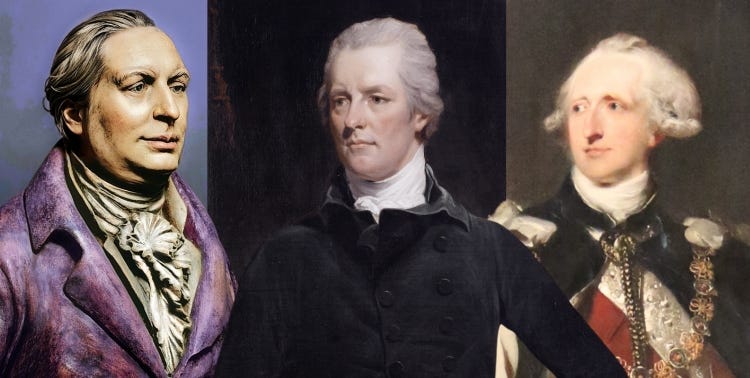
It is Friday, May 21 of 1790.
Gouverneur Morris walks into what he believed would be a routine Follow-up Meeting with the Duke of Leeds, Britain’s Foreign Secretary.
The Day before, the two discussed several festering Disputes between Britain and the United States — unpaid Debts, British Refusal to evacuate Frontier Posts, and the increasingly violent Practice of impressing American Sailors. Leeds postponed the Conversation to the next Afternoon.
Morris expected another dry, bureaucratic Exchange. A political zero-sum Exercise. Washington had sent him as an unofficial Observer with extremely limited Authority. A sharp Mind, yes, but no Power to negotiate.
Instead, Morris steps into a staged Scene.
Leeds is not alone. Sitting beside him is Prime Minister William Pitt. Young, brilliant, and absolutely prepared. It is a political Ambush. Leeds has constructed a controlled Environment with a senior Cabinet Member as Reinforcement — a calculated Setup for a managed Let-down.
They thought that without Warning, Preparation or Support, the American Envoy could be pressured.
But they underestimated Gouverneur Morris, who simply does what he does best:
stay steady, think fast, reply proper, calm and clever.
I. A Fight Over People, Not Paper
Pitt opens with the most sensitive Issue: Impressment — the British Seizure of American Sailors, who were then forced (“pressed” or “imprest”) into Royal Navy Service. Pitt offers a bureaucratic Band-Aid: perhaps the U.S. should issue Certificates proving a Sailor’s Nationality. Morris pushes back politely but firmly: A Certificate might be useful, he concedes, but the underlying Issue is that Britain treats Americans as if they were still colonial Dependents. No Paperwork can correct a Power Imbalance the Kingdom is actively exploiting.
Morris understands the Stakes better than most. Impressment wasn’t just a diplomatic Irritation; it drained the American maritime Workforce and undermined the young Nation’s Ability to defend itself. He had worked closely with Robert Morris during and after the War on shaping commercial and maritime Policy, and he recognizes the Strategy behind Britain’s Behavior: To him, Impressment isn’t an administrative Oversight — it is a calculated Pressure Tactic, a coercive Act operating just short of open Hostility.
When Pitt fails to land his Point, he pivots. He and Leeds suddenly accuse Morris of “misapprehending” Leeds’s earlier Letter about the Paris Peace Treaty of 1783. The Reason Morris sought out Leeds the Day before was to bring the Issue of Britain’s Inaction to the Table. The Crown has failed for seven Years to execute the Obligations it already agreed to — and, as lawyerly Morris says with disarming Simplicity,
“Generally Delay is always a Kind of Breach.” 1
His point is Razor-sharp: if Britain truly intended to honor the Treaty, it would have done so.
Pitt, trying to recover, points out that the Delays have rightly also caused Damage to their own Side. He suggests staying open to Negotiations on Agreements to remedy these “Inconveniences.” In doing so, he inadvertently confirms Morris’ initial Accusation.
Gouverneur remains calm. He recognizes that Britain is currently attempting to renegotiate its contractual Commitments rather than honor them. Pitt immediately admits this, and Morris answers with a Line so icily reasonable it stops the Gambit cold:
“It is idle to think of making a new Treaty until the Parties are satisfied about that already made.”
In other words:
“Stop trying to rewrite History. Honor what you already signed.”
It is the diplomatic Equivalent of a raised Eyebrow.
Morris points out again, that Britain’s Refusal to compensate Americans for Slaves taken and carried away by the British Army has become a national Grievance. Morris’ Diary still reflects his same Stance during the 1787 Constitutional Convention: Slavery is a Curse on the People. Once again he sees his “fellow Creatures” being treated like Property. He considers them part of the American Population and to him they are Victims and Individuals currently affected by War and Policy.
This was radical for the Era.
So, of course, diplomatically, he could not go into Whitehall arguing:
“These are American People whose Liberty you are violating.”
He must argue: “The Treaty forbids carrying away Property; you are violating the Treaty.”
It is the only argument the British are legally bound to answer. And Pitt immediately tries to minimize the Issue as trivial;
“too trifling an Object for them to make a specific Performance.”
He delivers Morris an Opening to strike:
“If it is trivial, then Britain should have no Objection to fulfilling its Obligations.”
It is Textbook Morris: polite enough not to offend, sharp enough to leave Bruises.
So Pitt diverts to the next Topic of Frontier Posts. Britain was still holding Military Garrisons on the U.S.’ northwestern Front, seven Years after the War. Pitt claims the Posts aren’t worth keeping. Morris remarks that if Britain truly believes that, they should simply hand them over. If they keep them on, it looks more like a Matter of national Pride, not Practicality — and the United States has an equal Claim to that Honor.
Pitt falls silent.
Morris’ Logic has him cornered.
So he turns the Game personal.
II. Morris Calls the Game
Pitt pulls a classic imperial Move: Insult dressed as Protocol. He asks, with a kind of polite Incredulity, why the United States hasn’t appointed a proper Minister. The Implication is clear:
“Why are you here, Mr. Morris? You’re a private Citizen.
Shouldn’t a real Diplomat be handling this?”
But this is where Pitt miscalculates. Morris isn’t improvising above his Pay Grade; he’s there because the President of the United States sent him. And he has been repeating that Point with polite but agonizing Clarity;
“I regret my limited Authority… I am merely acting under written Instructions from General George Washington himself.”
So when Pitt asks Morris — again — if he has the Power to treat, “I told him no,” Morris notes, “and that we could not appoint a Minister, because they had so much neglected the Minister formerly appointed.”
It is a perfect Counterpunch. Pitt tries to diminish him; Morris answers by pointing directly at Britain’s own diplomatic Failure. The Power Play collapses in on itself, and Morris ends up looking more official and more legitimate than the Men who just attempted to put him in his Place.
But only then comes the infamous Morris-Rapier:
“He asked if we would appoint a Minister if they did. I told him we should.”
This is Morris at his most lethal: polite, literal, and absolutely daring them to try him.
Morris smiles. Pitt laughs, embarrassed. Leeds is sweating in the Corner.
The American Civilian has just outplayed the Prime Minister of Britain in his own Foreign Secretary’s Office — and they all know it.
Busted by this near-lethal Blow the Conversation moves on to Communications. In a micro-Power-Play Pitt and the Duke order Morris to transmit what has been discussed. Morris assures them to do so — once he has everything in Writing.
“I do not like to transmit mere Conversation, because it may be misconceived and disagreeable Questions may arise, but that written Things remain and speak for themselves.”
A small but necessary final Morrisian Strike to deconstruct the initial Attack by Pitt and Leeds on Morris’ “Misapprehension” on the Treaty of Commerce-Letter. But being an ever conciliatory Diplomat and good Spirit, Morris tries to end the Conversation on a hopeful Note:
“The Disposition for having a good Understanding between the two Countries,”
he remarks, wasn’t just laid by the President’s Letter in sending himself to converse, but also reinforced by the Decision of the Legislature where the Majority of Congress agreed not to impose any further Restrictions on British Ships in U.S. Ports — such as the Certificates Pitt proposed would have been.
But that’s when the Prime Minister poorly attempts one final Climb at moral high Ground.
He says, “on the Contrary, you should rather give us particular Privileges — like the ones you enjoy here.”
His Suggestion that Britain has shown America “Privileges,” and that the U.S. ought to be grateful and reciprocate, does it for Morris.
Without flinching he delivers a Line so dry you can hear the Parchment curl:
“I tell him that I really know of no particular Privilege we enjoy
except that of being imprest, which of all others
we are least desirous to partake of.”

III. After the Smoke Clears
Pitt’s final Card: a limp Appeal to “Friendship.” The United States should grant Britain special Privileges — the Way Britain is supposedly indulging America.
Morris detonates.
Not by shouting.
Not by grandstanding.
But by calmly naming the Abuse of Power to the Face of the Abuser.
The British Cabinet, having spent Hours trying to minimize, deflect, confuse, and sidestep, abruptly concludes the Discussion with bureaucratic Vagueness:
“They promise to consult together,” Morris writes, “and give me the result.”
Which, translated from 18th-Century Whitehall, means:
“Please leave. Do not expect a Follow-up.”
But Morris walks out unfazed.
His next Move already in Motion.
He goes straight Home and writes to President Washington.
The Letter is sober, exact, and devastating. He recounts the Evasions, details the attempted Reversals, paints the political Theater — handing the General the only thing that matters:
the Truth, unfiltered, from inside the Lion’s Mouth.
This is why Washington trusted him with the hardest Assignments.
Morris never embroidered. Never softened. Never dissembled.
He delivered and represented the Interests of the young Republic with perfect Clarity.
And now Washington knows exactly where Britain stands:
Delay, not Goodwill.
Pressure, not “Privilege.”
Pretense, not Partnership.
Morris has done precisely what he was sent to do:
Expose the Truth without breaking the Peace.
Show Strength without Sabre-rattling.
Deliver Clarity where the British hoped for Confusion.
The Irony is perfect.
Pitt tries to put a “private Citizen” in his Place in that soft, condescending imperial Tone Britain reminds a former Colony of “its Place.”
“We will take your Friends and Families and leave our fully armed Battalions on your Doorsteps to remind you of our Love.”
But Morris was the only Man in that Room who understood every Angle of the Game.
“The only ‘Privilege’ we enjoy is that of being imprest
and I assure you, Mr. Prime Minister,
we are not impressed.”
This and all following Quotations:
Davenport, Beatrix Cary. A Diary of the French Revolution by Gouverneur Morris 1752-1816 Minister to France during the Terror. George G. Harrap & Co. Ltd., 1939. p.520-522.