

I. The Statue in Question
Why Fact Check a Statue of George Washington on a Site about Gouverneur Morris?
Because even when Morris is physically present in the Making and Shaping of American Memory, he has a Way of disappearing from the Record.
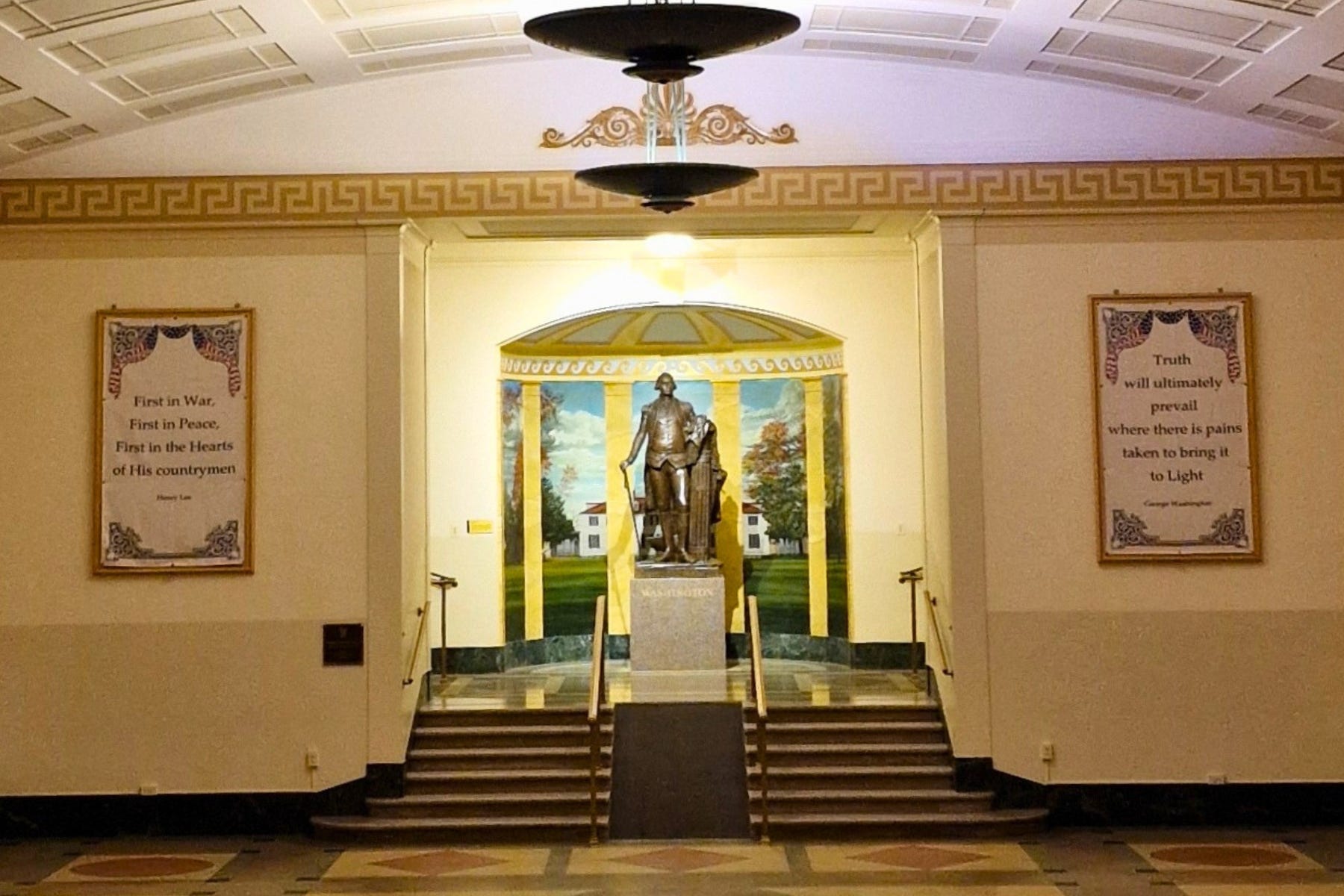
The Statue in Question is Jean-Antoine Houdon’s life-size marble George Washington, installed in the Rotunda of the Virginia State Capitol in Richmond.

It is one of the most famous and widely copied Images of the first US-President: Washington in Revolutionary Uniform, his Sword set aside, his Hand resting near a civilian Cane, the Fasces and Plow beside him.
Republican Power transformed into civic Restraint.
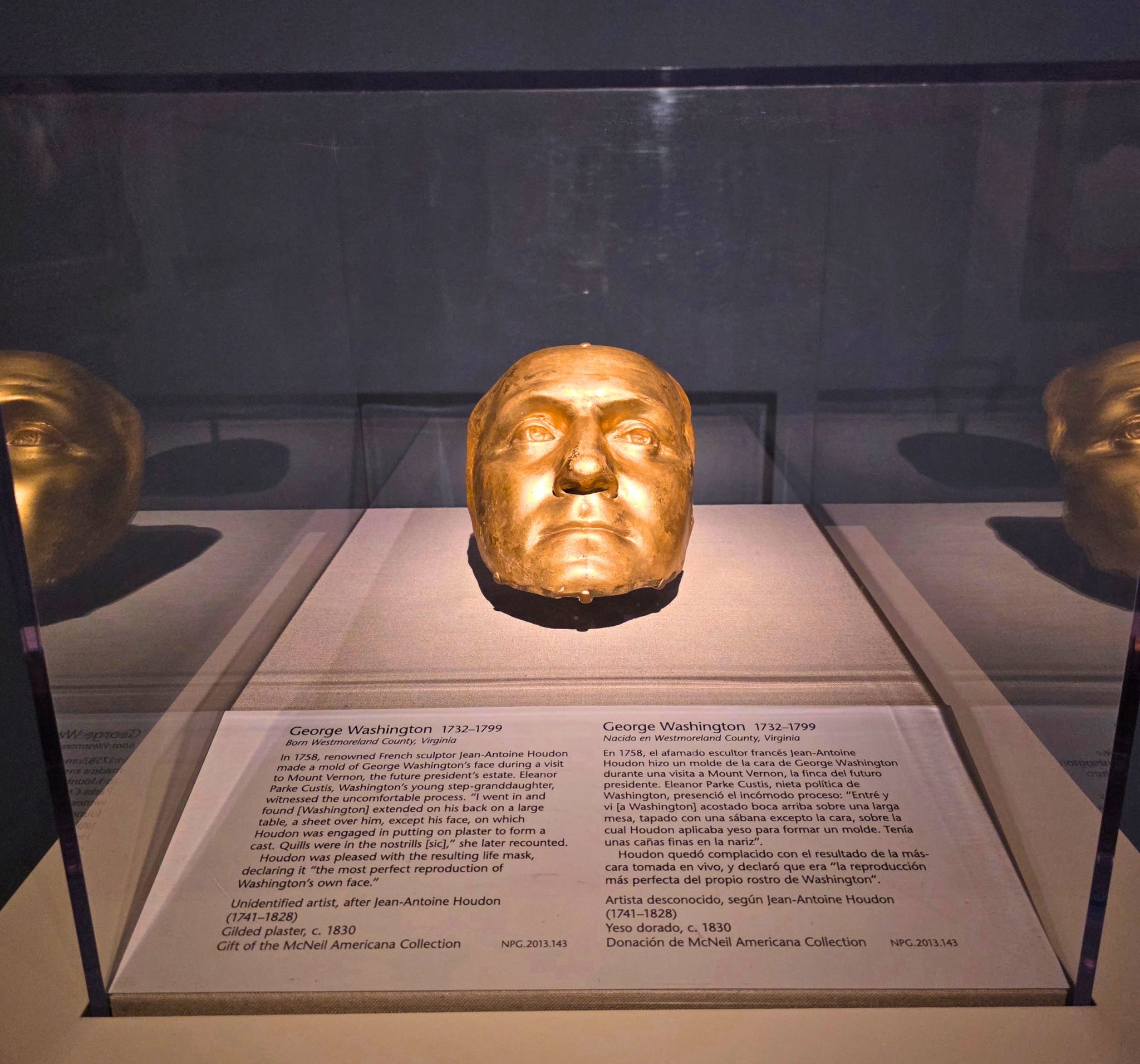
As the standard public History goes, Virginia commissioned the Statue in 1784. Houdon travelled to Mount Vernon in ‘85, took Washington’s Measurements, made a Life Mask, and later completed the Statue at Home in Paris. It was delivered to Richmond in 1796. Even Wikipedia preserves this Chronology in Detail.1
What the Article does not mention, however, is that while working on the full-length Figure in Paris, Houdon reached out to Thomas Jefferson with an urgent Request:
He wanted Gouverneur Morris.
As a Result, one of the most famous Statues of George Washington becomes a quiet Lesson in public Memory Making:
The finished Image survives — while the Body that helped shape it disappears.
II. Shaping Public History
In June 1784, the Virginia General Assembly commissioned a Statue »of the finest Marble and best Workmanship«2 and asked Thomas Jefferson, then serving in Paris, to engage a Sculptor. With Houdon, Jefferson secured one of the most celebrated Craftsmen of his Time.
But the Master did not want to work from a Painting alone, so he crossed the Atlantic and visited Washington at his Home, where he made a Plaster Mask of the General’s Face and took detailed Measurements of his Body. The Statue itself was then carved in France from Carrara Marble, shipped to America in early 1796, and placed in the Rotunda of the Virginia State Capitol (designed by Thomas Jefferson) roughly 12 Years after Commissioning.
The finished Washington is not shown as an Aristocratic Plantation Owner, Roman Emperor or Marble Demigod. The Symbolism is clear: Soldier, Statesman, private Citizen, republican Cincinnatus — Man of the People, for the People.
III. The Fracture in the Figure
Washington’s Body was already being turned into public Form. The Depictions followed along the Lines of the General’s self-Description of being »rather slender than corpulent«3 and even in 1797 Washington was still described as »distinguishable for Muscle rather than Flesh.«4
His Face followed the same Logic. William Williams’ 1794 Masonic Portrait constitutes a Break from the Rule of the polished public Image. Washington appears scarred, reddened, and marked by a Mole under his Ear.
The Memorial’s Tour Guide and the Naval Institute offer the same likely Explanation for this unusual Bluntness: the Painting was made »for his Brethren in the Lodge and as such might probably have not been expected to reach the general Public«5
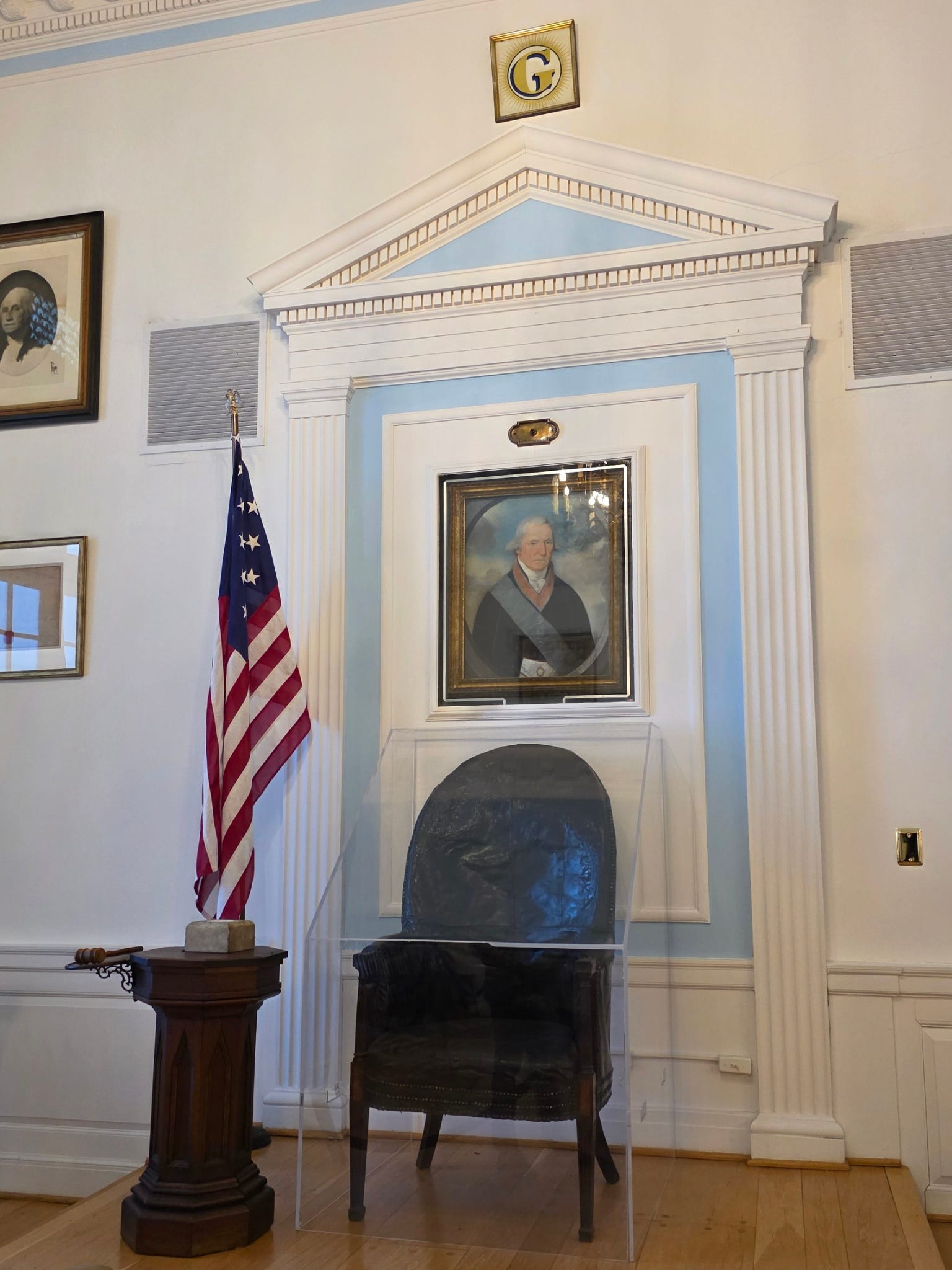
My Point is not to prove Vanity, but Mediation. Washington’s Body and Face were already Subject to Description, Selection, and artistic Management.
Houdon’s Statue continued that Process, turning Anatomy into Architecture.
And it is at this Point, that Morris appears.
IV. A Body Erased
June 1789 he writes in his Paris-Diary:
Thursday 4. — After Dinner take a Ride. Returning, call on Mr. Jefferson who is abroad. Meet him and take him in my Carriage as I return from his House. After a Tour go back to await the Arrival of Mr. Short who went this Morning to Versailles. Mr. Jefferson requests, on the Part of Mr. Hudon the Statuary, that I would stand tomorrow for the Figure of General Washington, to which I consent.
Friday 5. — Go to Mr. Hudon’s. He has been waiting for me a long Time. I stand for his Statue of Genl. Washington, being the humble Employment of a Manakin. This is literally taking the Advice of St. Paul to be all Things to all Men. Promise Mr. Hudon to attend next Tuesday Morning at half past eight to have my Bust taken, which he desires to please himself6; for this is the Answer to my Question, what he wants with my Bust. A Question dictated with a View to obviate any future Demand of Payment from me.7
This Fact changes the Object:
Washington supplied the Face, the Measurements, the public Meaning.
Houdon supplied the Form, the Marble, the republican Iconography.
But when the full-length Figure took shape in Paris, the Body beneath Washington was — at least in Part —
Gouverneur Morris’.
V . The Fact Check
The current Wikipedia Article preserves the standard Chronology of Houdon’s Washington and describes the Statue as one of the most accurate Depictions of the first President, also noting the extensive later Copying of the Image.
But it leaves out Morris.
His Involvement is not speculative, but a direct contemporary Record with physical Proof in the Shape of his surviving Life Mask.

The Statue therefore becomes a composite Object: Washington’s Likeness, Houdon’s Artistry, republican Symbolism, and Morris’ physical Presence, fused into one public Image.
Thomas A. Foster frames this Circumstance very elegantly in his Disability Studies Quarterly-Article around Morris as Washington’s recovered Body-Double, and around the way Disability complicates the heroic male Image of the Founding Generation. He notes that that several Biographies reproduce Houdon’s Washington as »standing in for Morris’s body in effect.« 8
That is the Fact Check: the Statue preserves Washington’s Image
by absorbing, hiding and mislabeling Morris’ Body.
VI. The Man Behind the Monument
The Omission not only changes the Object but the Record around it. It shows Historiography at work, preserving the finished Image and its public Meaning while obscuring the composite Labor behind it.
Morris’ Role exposes that Process — and with it, a Pattern:
He played a vital Part in Washington’s Service without becoming a visible Face of the Presidency, just as in 1790, when Washington sent him in an official Capacity to negotiate with Britain’s Prime Minister and Foreign Secretary.9
It is the political Analogy to Houdon’s Statue — Morris is present. Morris is useful. Morris is structurally important. And then… Morris disappears from the Lore.
This is why the Statue belongs on The Gentleman Founder as a visible Allegory for Morris’ historical Position: active in the Making, central to the Structure, absent from the public Label.
The heroic national Image stands upright, whole, controlled, republican, architectural and beneath it stands the Founder whose own Body could not be made to fit the preferred heroic Script, but whose Presence helped produce it.
Washington remains the Subject — Morris belongs to the Making.
“Statue of George Washington (Houdon).” Wikipedia, Wikimedia Foundation, https://en.wikipedia.org/wiki/Statue_of_George_Washington_(Houdon). Accessed 14 June 2026. At the time of access, the article did not mention Gouverneur Morris.
Underlined by Morris. No further Comment.
Davenport, Beatrix Cary. A Diary of the French Revolution by Gouverneur Morris 1752-1816 Minister to France during the Terror. George G. Harrap & Co. Ltd., 1939. p. 106-107.
On a personal Note I’d like to thank Houdon for his Service to Mankind, giving us this.
Foster, T., (2012) “Recovering Washington's Body-Double: Disability and Manliness in the Life and Legacy of a Founding Father”, Disability Studies Quarterly 32(1). doi: https://doi.org/10.18061/dsq.v32i1.3028