
Manuscript transcriptions of Gouverneur Morris material, with sources and OCR-friendly text.
The transcriptions preserve the original spelling, punctuation, capitalization, and grammatical irregularities of the manuscripts as closely as possible. Underlined words, uncertain readings, and illegible passages are indicated in brackets.
John Jones to Gouverneur Morris, 1 Nov 1790
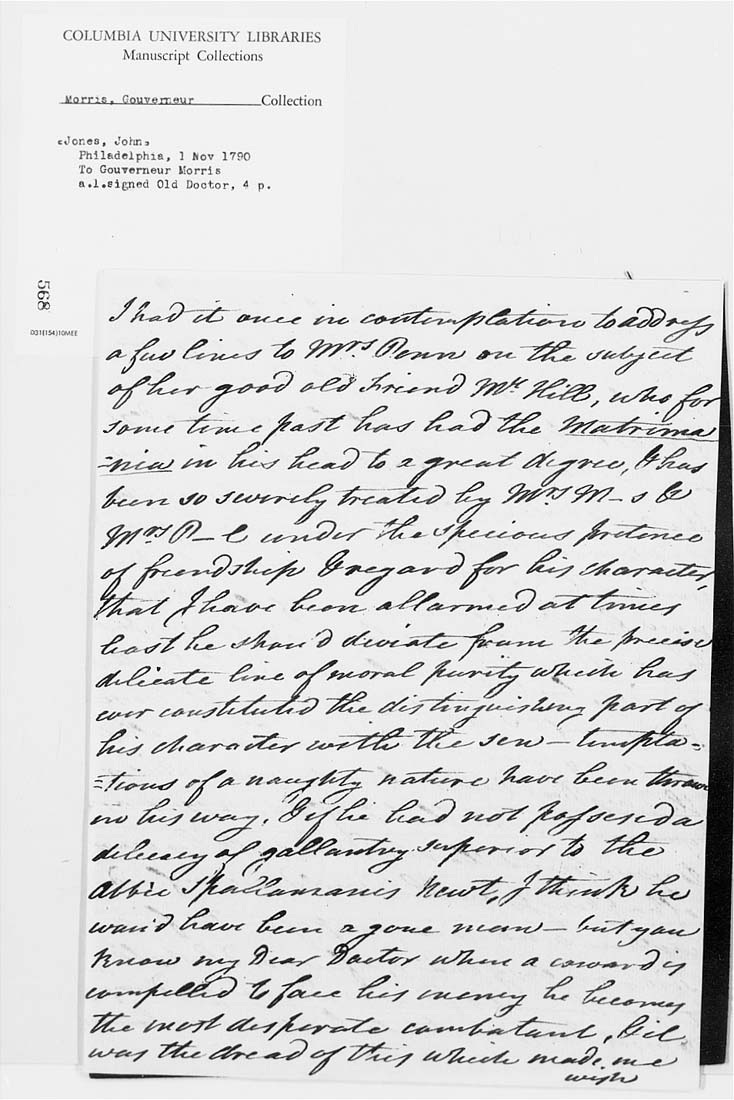
«Jones, John1»
Philadelphia 1 Nov 1790
To Gouverneur Morris
Signed «Old Doctor», 4 pages.
Source: Rare Book & Manuscript Library, Columbia University Libraries, Gouverneur Morris Papers.
I had it once in contemplation to address a few lines to Mrs. Penn on the subject of her good old friend Mr. Hill, who for some time past has had the Matrimainia (underlined) in his head to a great degree, & has been so severely treated by Mrs. M—s & Mrs. P—l under the specious pretence of friendship & regard for his character, that I have been allarmed at times lest he should deviate from the precise delicate line of moral purity which has ever constituted the distinguishing part of his character with the sex — temptations of a naughty nature have been thrown in his way. If he had not possessed a delicacy of gallantry superior to the [ Albic ] [ illegible ] Newt, I think he would have been a gone man — but you know my Dear Doctor when a coward is compelled to face his enemy he becomes the most desperate combatant, viz was the dread of this which made me wish2 hear Mrs. Penns opinion & I shou‘d really have written to request it, but my courage fail‘d me — if ever I had any talents for correspondence with ladies, those Days my Dear Doctor, are Alass! no more — even the good natured obliging creatures who used to visit the green room where you lived with me opposite the shambles, have now forsaken me, ungrateful Jades! They ought at least to remember my past services, but even the muses like other Jades swift says, treat a man the worse for every year added to his life. recollect this my dear Doctor! & write verses while you remain on the top of Parnassus. or to your friend the Old Doctor, all his views of happiness in this world are confined within a narrow compass — the fire side — an easy chair, a few good books & two or three old friends who are good enough to to visit him, constitute his summum bonum. Once more my Dear Doctor, what are you doing? how many years will you suffer to pass away in projecting schemes of happiness which may never happen, while you neglect those within your grasp — return, then, to your native country — it is the best I ever saw, at least for an American — employ the talents which heaven has so bountifully bestowed upon you in promoting order & good government so essential to the political happiness. of a constitution you had no inconsiderable share in framing — leave law trafficing speculations to those who are fit for nothing better — the character of an Upright Statesman & able Legislator will become you infinitly more — these are the opinions of your truest friends & particularly your most sincere am the Old Doctor
Philadelphia Novr. 1st. 1790
P.S. When you meet any of my old American friends who have not forgot me pray remember me to them; but particularly Mr. & Mrs. Penn — if you ever see Monsr. LaLuzernes I beg you to assure him I can never forget the numerous instances of politeness & attention I have received from him in Philadelphia, & that I shall always be happy to hear of his health & prosperity. Mrs. Clark & Miss Dally desire me to offer their best wishes for your own health & happiness.
John Jones to Gouverneur Morris, May 1791
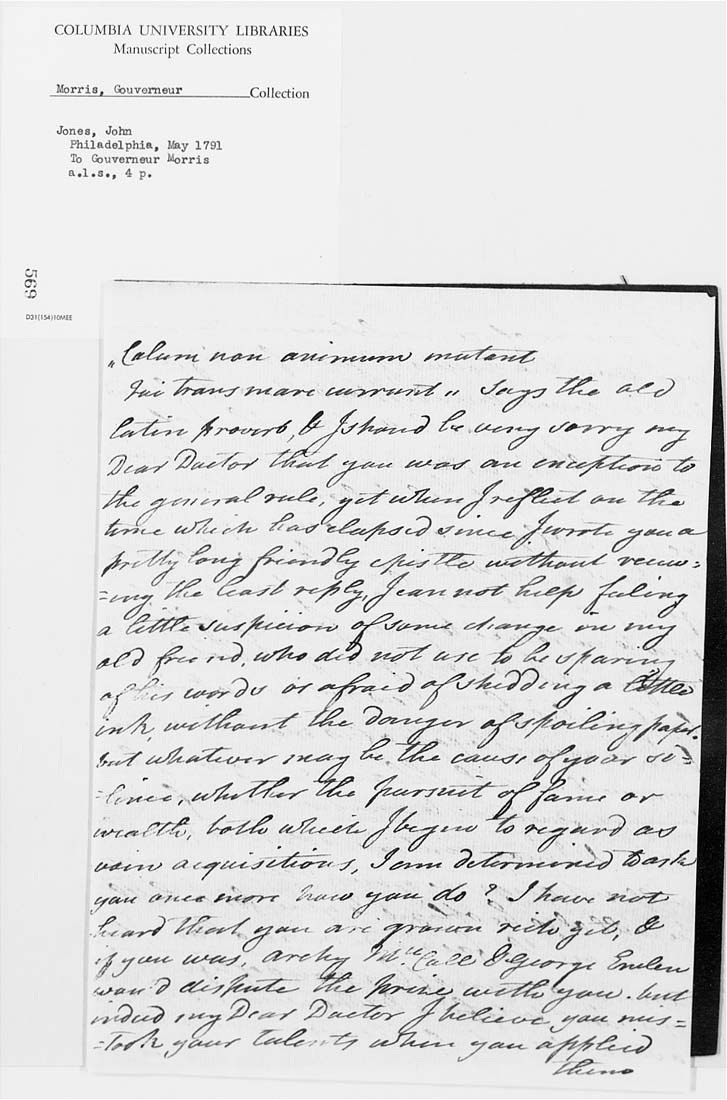
«Jones, John»
Philadelphia May 1791
To Gouverneur Morris
4 pages.
Source: Rare Book & Manuscript Library, Columbia University Libraries, Gouverneur Morris Papers.
“Caelum non animum mutant qui trans mare currunt.”3 Says the old Latin proverb, & I shoud be very sorry my Dear Doctor that you was an exception to the general rule, yet when I reflect on the time which has elapsed since I wrote you a pretty long friendly epistle without receiving the least reply, I can not help feeling a little suspicion of some estrange in my old friend, who did not use to be sparing of his words or afraid of shedding a little ink whatever may be the cause of your silence, whether the pursuit of fame or wealth, both which I begin to regard as vain acquisitions, I am determined to ask you once more how you do? I have not heard that you are grown rich yet, & if you was, [ archy ] Mr. [ Call & George Emlen ] wou‘d dispute the prize with you. but indeed my Dear Doctor I believe you mistook your talents when you applied them to the science of accumulating wealth, which was never the genius of your family, who have in general understood the art of spending money much better than that of geting it, & I sincerely wish you may be convinced of this truth before you have spent too much of your own. so much for advice without a fee, which you know I do not give gratis to everybody — permit me now to introduce to your friendly offices Mr. James Jones my youngest brother who lately sailed from New Orleans to Bordeaux & as he means to pass a few months at Paris you will sensibly oblige me by giving him an introduction to some of your friends there, & I may venture to assure you he will not disgrace your recommendation he will also be obliged to you for a little advice on the facon de vivre a Paris, becoming a man of his period of life which is about forty five & who wishes to live in style of genteel œconomy. he proposes to pass the winter in London where I hope he will have the pleasure of your acquaintance in person, & any letters you may favor him with to Paris may be addressed to him at Mr. Shorts our chargé des affaires, to whom Mr. Jefferson has given him an introductory letter. when he has satisfied his curiosity in the two Capitals of France & England he means to return in the Spring to his friends & native country, & may then form a comparative view of the different countries he has seen, with that of his own, which is so much changed since he saw it, that it would be almost as new to him as those he never saw before — you may possibly stare a little yourself when you revisit the Capital of the United States, where men & women & things are not or little metamorphosed since you & I first knew them — but what is there in this mutable scene which is not continually changing — even you & I my Dear Doctor are not the same beings we were thirty odd years ago, & what or where we shall be in a similar period he who ordered us here only knows. in the mean time I trim the old barque & keep her in the best possible repair I can, so that if you do not put off your return about a year or two longer you may probably see her before she crosses the Styx. a passage my poor friend Frank took in haste a few days ago, in spight of his spring block4, & has left a chasm in my small circle of happiness, not easily fill’d up — our other friends in general are well, not excepting Mrs. Clarke & Miss Dally with whom the old Doctor has lived so long, he cou’d hardly live without them — Adieu my Dear Doctor! That you may live long & as happy as possible is the sincerest wish of your affectionate old Friend John Jones
Philada. May 1791
Gouverneur Morris’ Diary Entry for December 5, 1789
Saturday 5. — […] Go to Madame Necker’s to dine. Madame de Stahl comes in and at the Instigation of her Husband asks me to dine next Wednesday. At Dinner we converse pretty freely upon political Subjects and in Consequence of an Observation I make, Necker exclaims in English : ‘ridiculous Nation!’ He does not know that my Servant understands English. After Dinner in the Salon I take him aside to ask if he has considered my Preposition. He tells me that a Colo. Ternant has a Plan. I tell him that the one I now give is the same. That my last Proposition was the utmost which the Houses here would agree to and therefore what I now offer is without their Participation. He asks if we are prepared to lay down the french Effects. I tell him no. He says he cannot listen to Propositions which give him no solid Security. I reply that no House in Europe is sufficient for so large a Sum and therefore Security as such is Nonsense but that he shall run no Risque for he shall not part with the Effects till he receives the Payment. He objects that he will still have no Certainty of the Paymt. and wants to know how I shall make the Operation, I tell him that it is by Means of our Connections in America and in Holland that we can do the Business better than he can, and therefore we can give him better Terms than he can obtain from others. He insists that the Proposition shall be supported by solid Security before he will consider it. I tell him that this is not just. That there are two Points for his Consideration ; first whether the Offer is good and secondly whether he is sufficiently secured. That if the Offer is not good it is needless to talk of Security but if it be such as he ought to accept then it will be proper to know what Kind of Responsibility will be sufficient. In the mean Time it would render me ridiculous to ask Security for Performance of a Bargain not made. To this he replies that if I once get his Promise I shall make Use of it as a Ground to negotiate upon and go about knocking at the Doors of different People. This is not a very delicate Comparison. I reply in a Tone of Dissatisfaction, mingled perhaps with a little Pride, that I shall knock at no Doors but such as are already open to me. Our Conversation is loud. He makes it so purposely ; and at this Point Madame de Stahl, with the goodnatured Intention of avoiding Illhumor, desires me to send her Father to sit next to her. I tell her smiling that it is a dangerous Task to send away Monsr. Necker and those who tried it once had sufficient Cause to repent of it. This little Observation brings back good humor and he seems inclined to talk further with me, but I take no farther Notice of him, and after chatting a little with different People I take Leave.
Source: Gouverneur Morris, Diary Entry for December 5, 1789, in A Diary of the French Revolution, 1752–1816, ed. Beatrix Cary Davenport (Boston: Houghton Mifflin Company, 1939), vol. 1, pp. 324–325. Transcribed from the printed Edition.
Übersetzung von Gouverneur Morris’ Tagebucheintrag für den 5. Dezember 1789
Samstag 5. — […] Gehe zu Madame Necker zum Diner. Madame de Stahl kommt herein und lädt mich auf Veranlassung ihres Ehemannes für kommenden Mittwoch zum Essen ein. Beim Diner sprechen wir recht freimütig über politische Themen, und infolge einer Beobachtung meinerseits ruft Necker auf Englisch aus: »Lächerliche Nation!« Er weiss nicht, dass mein Diener Englisch versteht. Nach dem Diner nehme ich ihn im Salon beiseite und frage, ob er meinen Vorschlag erwogen habe. Er sagt mir, ein Colo. Ternant habe einen Plan. Ich sage ihm, derjenige, den ich ihm nun vorlege, sei derselbe. Dass mein letzter Vorschlag das Äusserste war, worauf sich die hiesigen Häuser einlassen würden und was ich ihm jetzt anbiete, geschehe daher ohne ihre Beteiligung. Er fragt, ob wir bereit seien, die französischen Effekten zu hinterlegen.5* Ich sage ihm nein. Er sagt, er könne auf keinen Vorschlag eingehen, der ihm keine solide Sicherheit biete. Ich erwidere, kein Haus in Europa sei für eine so grosse Summe ausreichend weshalb Sicherheit wie solche Unsinn sei aber er werde kein Risiko tragen, denn er müsse die Effekten nicht aus der Hand geben, bevor er die Zahlung erhalte. Er wendet ein, er habe dennoch keine Gewissheit über die Zahlung, und will wissen, wie ich die Operation durchführen wolle. Ich sage ihm, dass wir durch unsere Verbindungen in Amerika und Holland das Geschäft besser ausführen könnten als er und ihm daher bessere Bedingungen bieten könnten, als er von anderen erhalten würde. Er besteht darauf, der Vorschlag müsse durch solide Sicherheiten gestützt sein, ehe er ihn überhaupt erwägen werde. Ich sage ihm, dies sei nicht gerecht. Zwei Punkte seien von ihm zu prüfen: Erstens, ob das Angebot gut sei, und zweitens, ob er hinreichend abgesichert sei. Sei das Angebot nicht gut, so sei es müssig, über Sicherheit zu sprechen. Sei es aber eines, das er annehmen solle, dann sei zu bestimmen, welche Art von Haftung genügen werde. Unterdessen würde ich mich lächerlich machen, wenn ich Sicherheiten für die Erfüllung eines Geschäfts verlangte, das noch gar nicht abgeschlossen sei. Darauf erwidert er, sobald ich erst sein Versprechen habe, werde ich es als Grundlage für weitere Verhandlungen benutzen und umhergehen und an die Türen verschiedener Leute klopfen. Das ist kein besonders feiner Vergleich. Ich antworte in einem Ton des Missfallens, vielleicht mit ein wenig Stolz vermischt, dass ich an keine Türen klopfen werde ausser an solche, die mir bereits offenstehen. Unser Gespräch ist laut. Er macht es absichtlich dazu ; und an diesem Punkt bittet mich Madame de Stahl, in der gutmütigen Absicht, Missstimmung zu vermeiden, ihren Vater zu ihr hinüberzuschicken, damit er neben ihr Platz nehmen kann. Ich sage ihr lächelnd, es sei eine gefährliche Aufgabe, Monsieur Necker fortzuschicken, und jene, die es bereits versucht hätten, hätten hinreichenden Grund gehabt, es zu bereuen. Diese kleine Bemerkung stellt die gute Stimmung wieder her und er scheint geneigt, weiter mit mir zu sprechen, doch ich beachte ihn nicht weiter, und nachdem ich noch ein wenig mit verschiedenen Leuten geplaudert habe, verabschiede ich mich.
Quelle: Gouverneur Morris’ Tagebucheintrag vom 5. Dezember 1789, in A Diary of the French Revolution, 1752–1816, ed. Beatrix Cary Davenport (Boston: Houghton Mifflin Company, 1939), vol. 1, S. 324–325. Transkribiert aus der gedruckten Aufgabe.
John Jones, Born1729 in Jamaica, New York, Died June 23, 1791 in Philadelphia, Pennsylvania — one Month after the second Letter’s Date.
Editorial Note: The Manuscript Page ends here and resumes on the next, so the Old Doctor’s “to” must have fallen between the Parchment Slides.
“They change their Sky not their Soul who cross the Sea” — Horace
spring block: I could not conclusively identify this Expression. Without further parallel Examples I remain uncertain, whether Jones is using a technical, medical, or idiomatic Term. References to contemporary Usage would be very welcome.
Mit “französischen Effekten” sind handelbare französische Staatspapiere gemeint. Morris und Parker wollten sie Frankreich im Austausch gegen die von Frankreich gehaltenen amerikanischen Schuldtitel liefern.